
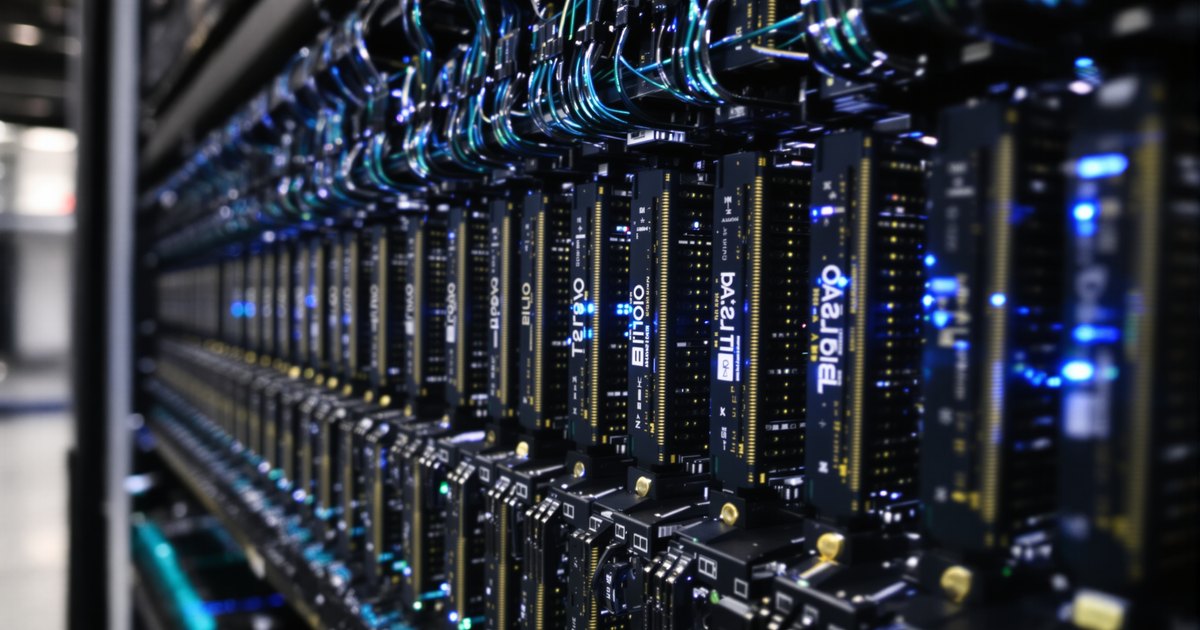
Every mainstream server, from a Dell PowerEdge to a Supermicro board in a rack, uses registered DIMMs. Desktops never do. The reason is not speed and not ECC, both of which are available on unbuffered memory; it is the number of memory chips a channel has to drive. This guide explains the electrical problem, what the register solves, how it enables the capacities servers need, and where LRDIMM and MRDIMM fit.
The short answer
A memory channel is shared wiring. Every chip on every module in the channel loads the address and command lines, and past a certain load the signals cannot be driven at speed. A register on the module takes those signals from the controller as one load and redistributes them to the chips, so a channel can carry two large modules with dozens of chips each. That is how a server socket reaches 1TB, 2TB or more. Desktops, with two modules of sixteen chips, never hit the limit, so they skip the register and its latency.
The electrical problem
Picture the address and command bus from the processor as a single set of wires visited by every DRAM chip in the channel. A 16GB desktop UDIMM has eight chips on one side; the controller drives sixteen loads for two modules and manages. A 64GB dual-rank server module carries 36 chips including ECC. Two per channel is 72 loads on each address line, at DDR5 speeds, which no controller can drive cleanly. The register fixes it: the controller drives one register per module, and the register, with its own drivers, fans out to the chips on the following clock. The loads on the controller's bus drop from 72 to two.
What it costs and what it buys
| ECC UDIMM | ECC RDIMM | |
|---|---|---|
| Address and command | Driven directly by the controller | Buffered by a register on the module |
| Latency | Baseline | About one clock added |
| Chips per module | Up to 18 | Up to 40 (with stacked dies, more) |
| Largest DDR5 module | 64GB | 256GB |
| Modules per channel at speed | 2 | 2, with the table speed |
| Platforms | Core, Ryzen, Xeon E, EPYC 4004 | Xeon Scalable, Xeon W, EPYC 7000 and 9000, Threadripper |
| Capacity per socket | 128GB to 192GB | 2TB to 6TB |
The ECC UDIMM vs ECC RDIMM guide covers why the two never swap; the memory types guide places both alongside SODIMM and LRDIMM.
Capacity, not speed
Registered memory is sometimes assumed to be faster because it is the server option. It is not. At a given speed grade an RDIMM is a clock slower than a UDIMM. What a server buys with the register is the ability to run twelve channels with two 64GB modules each at a supported speed, which is 1.5TB on one socket. A desktop controller cannot address that much, and a desktop board could not drive it if it could. For a database or a virtualization host, capacity is the performance metric, and RDIMM is how it is reached.
LRDIMM and MRDIMM
On DDR3 and DDR4, the largest modules needed more than a register. Load-reduced DIMMs buffer the data lines too, so the channel sees one load per module for data as well as address, which is how 128GB DDR4 modules were built. DDR5 RDIMMs reach 128GB and 256GB without that, so DDR5 LRDIMMs are rare. The next step is the multiplexed rank DIMM, which uses a data buffer to combine two ranks into one faster stream and reaches DDR5-8800 on Intel Xeon 6; the RDIMM vs MRDIMM vs MCRDIMM guide covers it. The guide to why RDIMM and LRDIMM cannot be mixed covers the one rule that follows from all this buffering.
A short history
Registered modules appeared with SDRAM in the late 1990s when servers first outgrew what a controller could drive, became standard with DDR and DDR2, and have been the server norm since. The history of computer memory places them in the timeline.
Buying
DDR5 RDIMM for current Xeon, EPYC and Threadripper platforms, including DDR5-6400 RDIMM for the newest; DDR4 RDIMM and LRDIMM for the installed base. Model-level listings for Dell PowerEdge, HPE ProLiant, Lenovo ThinkSystem and Supermicro carry the right module for each system.
Frequently asked questions
Is RDIMM faster than UDIMM?
No. The register adds one clock of latency. RDIMM exists for capacity and signal integrity, not speed; its advantage is holding far more memory per channel at a supported speed.
Can a server use UDIMM instead?
Only entry servers built on desktop-class controllers (Xeon E, EPYC 4004), which take ECC UDIMM and top out around 128GB to 192GB. Xeon Scalable and EPYC 9000 servers take RDIMM only.
What is the difference between RDIMM and LRDIMM?
RDIMM buffers the address and command lines. LRDIMM also buffers the data lines, so the channel sees one load per module however many chips it carries. LRDIMM was the route to 128GB modules on DDR4; DDR5 RDIMM reaches those capacities without it.
Why are DDR5 RDIMMs keyed differently from DDR5 UDIMMs?
To stop the two being swapped. DDR4 shared a key and the mistake reached the point of a failed boot; DDR5 moved the notch so the wrong module will not seat.
Memory for workstations, servers and fleets
Servers use RDIMM because it is the only way to put a terabyte on a socket, and that is what we stock. Request a quote with your systems and quantities, or contact our sales team. Related: data center server memory, business fleet memory and education and government.