
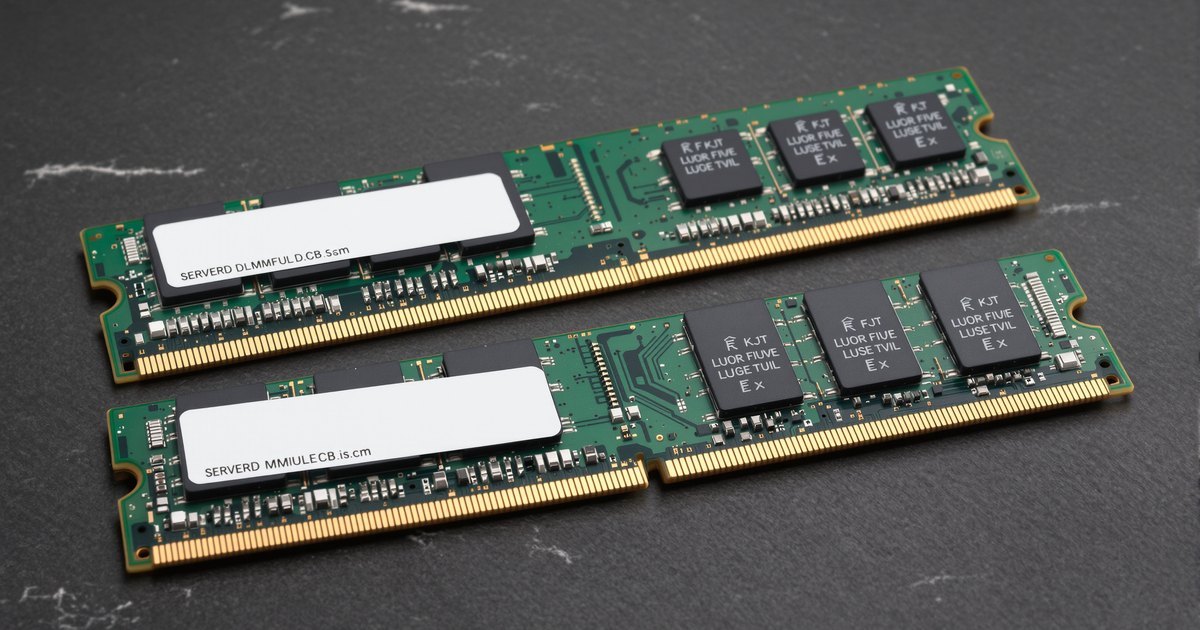
Two modules can both say DDR5, ECC, 32GB and the same speed and still be useless in each other's slots. ECC UDIMM and ECC RDIMM carry the same error-correcting memory but talk to the processor in different ways, and a platform is built for one or the other. This guide explains the difference, how to tell which your system takes, and why the mistake is so common.
The short answer
- ECC UDIMM is unbuffered: the processor drives the memory chips directly. It is what desktops, workstations on Ryzen and Core, and entry servers (Xeon E, EPYC 4004) use.
- ECC RDIMM is registered: a buffer chip on the module relays address and command signals. It is what Xeon Scalable, EPYC 7000 and 9000, Threadripper PRO and Threadripper 7000 use.
- The memory controller in the processor decides. There is no board setting that changes it.
What the register does
A memory channel is a set of wires shared by every chip on every module in it. The more chips hang on those wires, the harder they are to drive at speed. An unbuffered module presents every DRAM chip to the controller as a separate load, which is fine for two modules of eight or sixteen chips each on a desktop. A registered module puts a register between the controller and the chips: the controller talks to one register per module, and the register fans the signal out to the chips a clock later. That is how a server channel can carry two modules of 36 chips each, and how a socket can reach 1TB or more. The cost is one clock of latency and a slightly higher price.
The memory types guide places RDIMM alongside LRDIMM, which buffers the data lines as well, and the guide to why servers use RDIMM explains the capacity arithmetic.
Why they cannot swap
A controller designed for registered memory sends its address and command signals timed for a register that will relay them. An unbuffered module has no register, so the timing is wrong and the controller fails to train the channel. The reverse is also true: a desktop controller does not know how to address a register. To prevent the mistake, JEDEC gives DDR5 UDIMM and DDR5 RDIMM different key-notch positions, so one will not seat in the other's slot. DDR4 UDIMM and RDIMM share a key, which is why DDR4 systems are where this error gets as far as a boot failure.
Which platforms take which
| Platform | Module | Notes |
|---|---|---|
| AMD Ryzen (AM4, AM5) desktops and workstations | ECC UDIMM where the board enables ECC | See does Ryzen support ECC |
| Intel Core desktops; Xeon W-1xxx and W-2xxx on W680 and C-series boards | ECC UDIMM | W680 workstation boards are the ECC route on Core |
| AMD EPYC 4004 and 4005; Intel Xeon E-2300 and E-2400 | ECC UDIMM | Entry servers with the desktop controller |
| AMD Threadripper 7000 and 9000 (TRX50) | DDR5 ECC RDIMM | Four channels |
| AMD Threadripper PRO (WRX80, WRX90) | DDR4 or DDR5 ECC RDIMM | Eight channels; see the WRX90 memory guide |
| Intel Xeon W-2400, W-2500, W-3400, W-3500 | DDR5 ECC RDIMM | Four or eight channels |
| Intel Xeon Scalable, Xeon 6; AMD EPYC 7000 and 9000 | DDR4 or DDR5 ECC RDIMM, LRDIMM on older platforms | Servers |
How to tell which you have
Read the module label or the system's memory page. "UDIMM", "unbuffered" or "ECC UDIMM" is one; "RDIMM", "registered" or "Reg ECC" is the other. On the board's specification page, the memory line says "ECC UDIMM" or "RDIMM/LRDIMM". If you are reading an installed module in the operating system, the Windows 11 memory check shows type and part number, and a part number search on the maker's site settles it. The guide to determining which RAM your board supports walks through the full check.
Buying
DDR4 ECC UDIMM and DDR5 ECC UDIMM for Ryzen, Core, Xeon E, EPYC 4004 and W680 systems. DDR4 RDIMM and DDR5 RDIMM for Xeon Scalable, EPYC, Threadripper and Xeon W. Every listing title states the type, and model-level listings for Dell, HPE, Lenovo, Supermicro and workstation makers already carry the right one.
Frequently asked questions
Can I put an ECC RDIMM in a workstation that takes ECC UDIMM?
No. The module is keyed differently and the memory controller cannot talk to the register. A Ryzen, Core or Xeon E platform takes UDIMM only.
Can I put an ECC UDIMM in a server that takes RDIMM?
No. Xeon Scalable, EPYC and Threadripper PRO controllers expect the register on every module and will not train an unbuffered DIMM.
Are DDR5 RDIMM and DDR5 UDIMM the same size?
Both are 288-pin and the same length, but the key notch is in a different position, so one will not seat in a slot made for the other.
Which do I need for an AMD EPYC 4004 or Intel Xeon E-2400 server?
ECC UDIMM. Those entry server platforms use the desktop memory controller with ECC enabled, not the registered controller of the larger chips.
Memory for workstations, servers and fleets
Every NEMIX listing states UDIMM or RDIMM in the title, because the two are never interchangeable. Request a quote with your systems and quantities, or contact our sales team. Related: data center server memory, business fleet memory and education and government.