
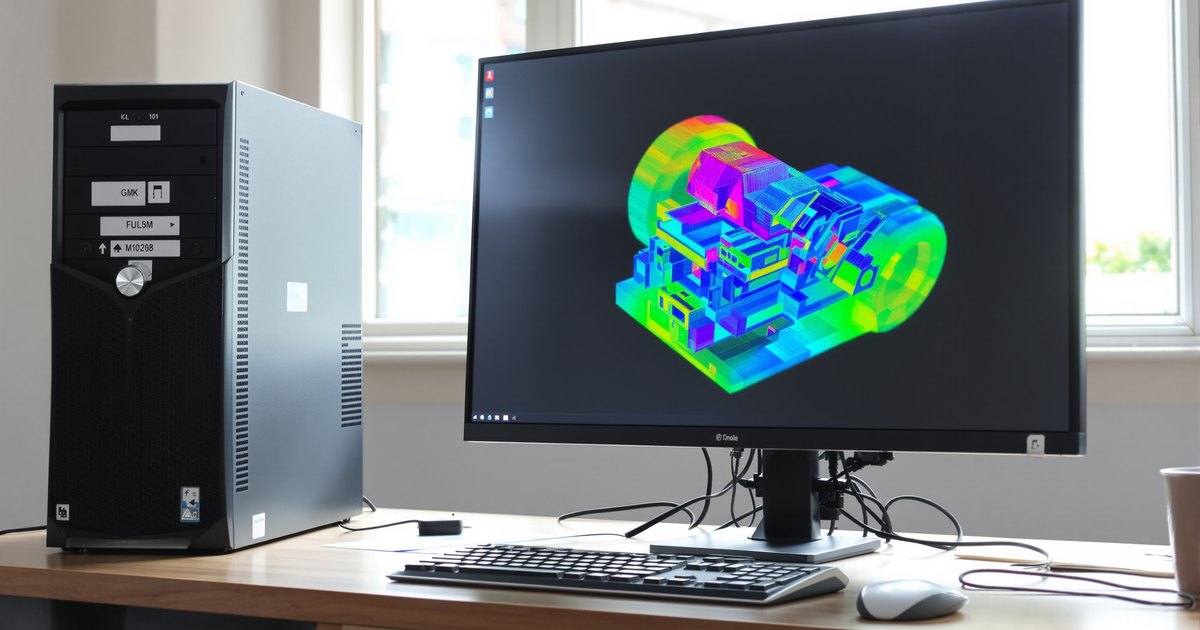
WRX90 workstations suit engineering teams because they combine up to 96 cores with eight channels of DDR5 ECC memory and up to 2TB of capacity. CAD itself rarely needs that much; the simulation side does. Finite element analysis (FEA) and computational fluid dynamics (CFD) need capacity to hold the mesh and bandwidth to stream it through every core on every iteration. This guide shows how to size WRX90 memory for engineering work.
CAD, CAE and simulation need different things
| Work | What limits it | Memory need |
|---|---|---|
| 3D CAD modeling and drawings | Clock speed, mostly single-threaded | Modest: 64 to 128GB covers large assemblies |
| FEA (structural, thermal) | Cores, memory capacity and bandwidth | Scales with model size and core count |
| CFD | Memory bandwidth and core count | Scales with cell count; often bandwidth-bound |
| Multiphysics and parametric sweeps | Many runs at once | Capacity for several models in memory |
Sizing memory by core count
Puget Systems suggests 4 to 8GB of memory per physical core for scientific computing. On WRX90, with eight identical modules, that maps to these kits:
| Cores (WRX90) | Memory at 4GB per core | Memory at 8GB per core | Eight-module kit |
|---|---|---|---|
| 16 | 64GB | 128GB | 8 x 16GB |
| 32 | 128GB | 256GB | 8 x 32GB |
| 64 | 256GB | 512GB | 8 x 64GB |
| 96 | 384GB | 768GB | 8 x 64GB to 8 x 96GB |
Treat this as a starting point. The largest model you run, and your solver's own guidance, set the final number. Leave headroom: a model that just fits today will not fit after the next mesh refinement.
Bandwidth: why channels matter as much as cores
Puget notes that mesh-based FEA and CFD solvers may be memory-bound, and Intel's Ansys Fluent paper calls memory bandwidth often a constraint. WRX90's eight channels at DDR5-6400 deliver about 409.6GB/s, shared by every core:
| Processor cores | Bandwidth per core at DDR5-6400 (8 channels) |
|---|---|
| 16 | About 25.6 GB/s |
| 32 | About 12.8 GB/s |
| 64 | About 6.4 GB/s |
| 96 | About 4.3 GB/s |
That is why a mid-core Threadripper PRO can match a higher-core part on bandwidth-bound solvers, and why all eight channels must be filled. Four modules halve the total. See eight-channel population on WRX90 and capacity vs speed vs bandwidth.
Platform choice for engineering
- WRX90: up to 96 cores, 8 channels, up to 2TB. The fit for large simulations.
- TRX50: up to 64 cores, 4 channels, up to 1TB. Enough for mid-size models; see when to choose WRX90 instead of TRX50.
- Intel W790: Xeon W-3400 and W-3500 offer 8 channels of DDR5-4800 and up to 4TB; see what is Intel W790.
- Beyond one workstation: cluster-scale CFD moves to EPYC servers; see WRX90 vs EPYC.
Use ECC
Long runs make error correction worth having: a single flipped bit hours into a solve can corrupt results or crash the job. Every platform above uses ECC RDIMM. See the ECC vs non-ECC guide.
Memory for engineering workstations
NEMIX RAM lists DDR5 ECC RDIMM for WRX90 (ASUS Pro WS WRX90E-SAGE SE, ASRock WRX90 WS EVO), TRX50 (ASUS Pro WS TRX50-SAGE WIFI, ASRock TRX50 WS), W790 (ASUS Pro WS W790-ACE and W790E-SAGE SE) and complete workstations such as the Dell Precision 7960 and Lenovo ThinkStation P7. Browse all DDR5 RDIMM.
Frequently asked questions
How much RAM do I need for FEA or CFD?
It scales with model size and core count. Puget Systems suggests 4 to 8GB per physical core for scientific computing, so a 32-core workstation lands at 128 to 256GB and a 96-core one at 384 to 768GB. Your solver's documentation and your largest model decide the final number.
Does CAD need a WRX90 workstation?
Usually not. Interactive CAD is mostly lightly threaded and favors clock speed. WRX90 pays off on the simulation side: large meshes, many cores and memory bandwidth.
Why does memory bandwidth matter for simulation?
Mesh-based solvers stream large arrays through memory on every iteration. Puget notes FEA and CFD may be memory-bound, and Intel's Ansys Fluent paper says memory bandwidth is often a constraint. More channels keep more cores fed.
Should engineering workstations use ECC memory?
Yes. Simulations can run for hours or days, and a flipped bit can corrupt results or crash the run. WRX90, TRX50 and W790 all use ECC RDIMM.
Is a 96-core Threadripper PRO always faster for simulation?
Not always. With 8 channels shared by 96 cores, each core gets less bandwidth than on a 32-core part. Solvers that are memory-bound may scale better on fewer, faster-fed cores; check your solver's scaling data.
Buying for more than one system
IT teams and integrators that maintain engineering workstations for CAD and simulation teams can standardize on one kit per model. Request a quote with your models and quantities, or send us your system model and we will confirm the right module before you order.
Steps and rules are summarized from the vendors' published documentation; follow the guide for your exact model.