
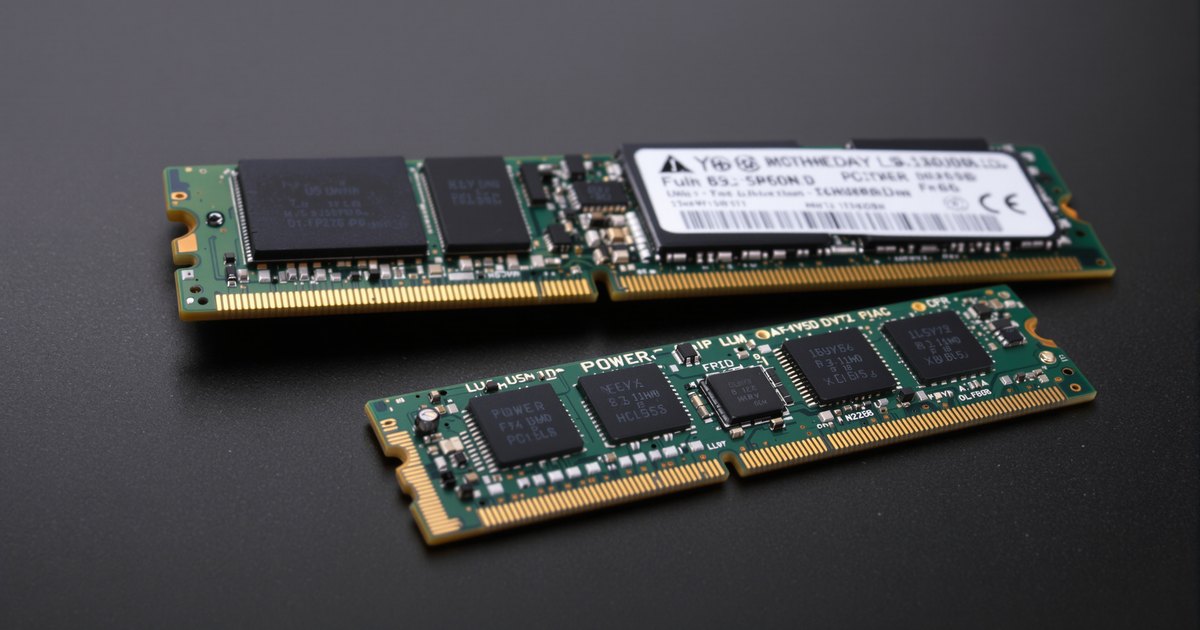
DDR4 and DDR5 overclocking follow the same idea, more speed or tighter timings than the JEDEC standard, but DDR5 changes the mechanics. Voltage is regulated on the module by a power management IC instead of the motherboard, each module carries two independent subchannels, profiles use XMP 3.0 or EXPO, and memory training takes longer. DDR5 reaches much higher speeds; DDR4 is more mature and predictable.
DDR4 vs DDR5 at a glance
| DDR4 | DDR5 | |
|---|---|---|
| JEDEC voltage | 1.2V | 1.1V |
| Voltage regulation | On the motherboard | On the module (PMIC) |
| Channel layout per module | One 64-bit channel | Two 32-bit subchannels |
| Top JEDEC speeds in wide use | DDR4-3200 | DDR5-4800 to DDR5-6400 and beyond |
| Profiles | XMP 2.0; DOCP and similar on AMD boards | XMP 3.0 (Intel), EXPO (AMD) |
| Memory training | Short | Longer, especially after a settings change |
| Typical tuning limit | Memory controller and board | Memory controller, board and PMIC |
What changes when you overclock DDR5
- PMIC on the module: overclocking kits use PMICs that allow higher voltages. Standard JEDEC modules commonly limit voltage adjustment.
- Controller ratios: on AMD Ryzen 7000, AMD has described DDR5-6000 as the sweet spot. Intel DDR5 platforms run the controller in Gear modes that set its ratio to the memory clock.
- Temperature: DDR5 modules report temperature through the SPD hub, which helps when tuning.
- Training time: expect slow first boots after each change. See how to reset BIOS after a failed overclock.
What carries over from DDR4
- Two modules overclock better than four. See two-DIMM vs four-DIMM boards.
- The processor's controller sets the ceiling. See how CPU memory controllers affect RAM overclocking.
- Every change needs testing. See how to test RAM stability after overclocking.
For DDR5 steps, see how to overclock DDR5 memory safely. For generation compatibility, see DDR4 vs DDR5: how chipsets and CPUs determine compatibility.
DDR4 and DDR5 RDIMM for servers and workstations
Servers and workstations run DDR4 or DDR5 RDIMM at the processor's rated speed, no overclocking involved. The generation is set by the platform. NEMIX RAM lists DDR4 RDIMM and DDR5 RDIMM by system, JEDEC-compliant and matched to each model.
Frequently asked questions
Is DDR5 harder to overclock than DDR4?
It has more variables. DDR5 adds an on-module power management IC, two subchannels per module and longer memory training, and the processor's memory controller limits are tighter at high speeds.
What voltage does DDR4 and DDR5 run at?
JEDEC DDR4 runs at 1.2V and JEDEC DDR5 at 1.1V. Overclocking profiles raise both; many DDR5 desktop profiles use about 1.35V.
Who controls memory voltage on DDR5?
A power management IC (PMIC) on the module. On DDR4 the motherboard supplied the memory voltage directly.
What is the best speed for DDR4 or DDR5 overclocking?
It depends on the processor. AMD has described DDR5-6000 as the sweet spot for Ryzen 7000. Ryzen 5000 systems commonly run DDR4-3600 to keep the memory and fabric clocks in step.
Can I overclock DDR4 or DDR5 RDIMMs in a server?
No. Server platforms run memory at the processor's rated speed. Choose DDR4 or DDR5 RDIMM by what your server takes.
Buying for more than one system
IT teams and integrators that maintain mixed DDR4 and DDR5 server fleets can standardize on one kit per model. Request a quote with your models and quantities, or send us your system model and we will confirm the right module before you order.
Steps and rules are summarized from the vendors' published documentation; follow the guide for your exact model.