
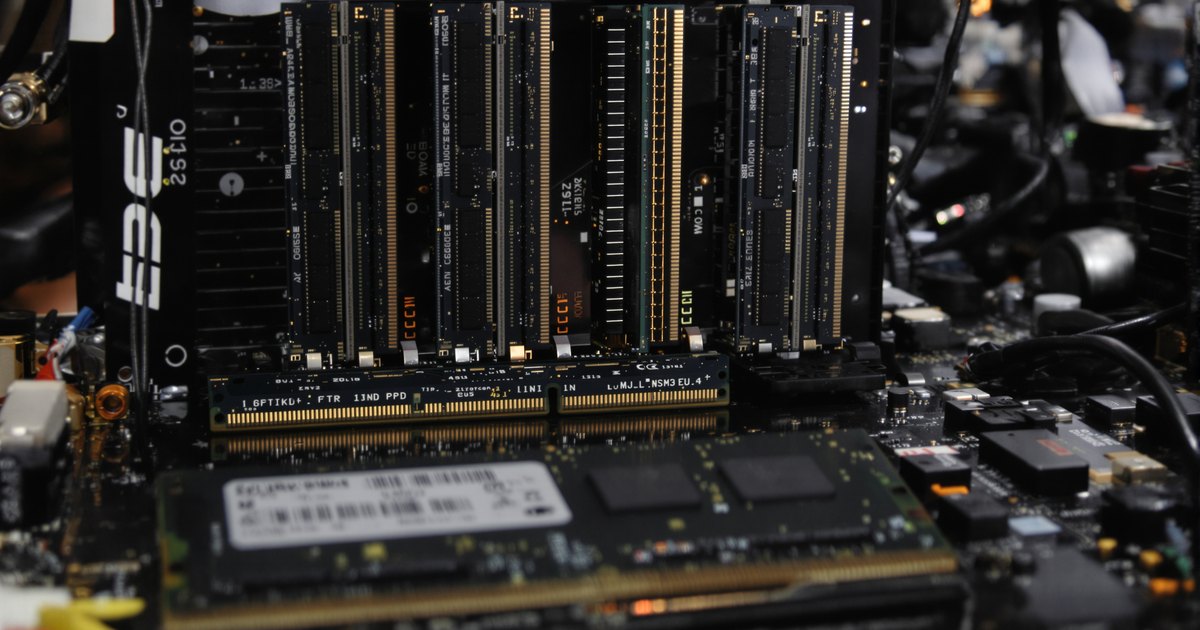
Yes. More RAM usually lowers overclocking potential, because more modules, more ranks and denser modules all add electrical load on the processor's memory controller. Two modules overclock better than four, and small single-rank modules reach higher speeds than large dual-rank ones. Even at stock settings, AMD lists DDR5-3600 for four modules on Ryzen 9000, versus DDR5-5600 for two. If you need capacity, choose capacity first and accept the lower speed.
Why capacity costs speed
| Change | Effect on the memory controller | Typical result |
|---|---|---|
| Four modules instead of two | Two modules per channel | Lower stable speed |
| Dual-rank instead of single-rank | More ranks per channel | Lower peak speed, often better per-clock performance |
| Larger, denser modules | More ranks or denser chips | Lower peak speed |
| Mixed kits | Unmatched modules | Harder to stabilize; avoid |
See single-rank vs dual-rank memory and two-DIMM vs four-DIMM boards.
Capacity or speed: how to decide
| Situation | Choose |
|---|---|
| Workload runs out of memory | Capacity. Swapping to disk is far slower than any memory speed gain |
| Workload fits with room to spare | Speed and timings, on two modules |
| Need both on a desktop | Two larger modules rather than four smaller ones |
| Need both on a workstation or server | More channels: fill them at one module each |
For how capacity, speed and bandwidth trade off, see capacity vs speed vs bandwidth.
Servers: capacity without overclocking
Servers solve the capacity-versus-speed problem with channels. Eight or twelve channels at one module each give large capacity at the processor's full rated speed; two modules per channel adds more capacity at a lower speed. No overclocking is involved. See why RAM runs slower when all slots are filled and dual, quad and eight-channel memory.
Memory that runs at its rated speed
NEMIX RAM modules are JEDEC-compliant and run at standard speeds with no profile to enable. For servers and workstations, see DDR5 RDIMM, DDR4 RDIMM and LRDIMM, or start from data center server memory. For stability context, see the ECC vs non-ECC guide.
Frequently asked questions
Does more RAM lower overclocking potential?
Usually. More modules, more ranks and denser modules all add load on the memory controller, which lowers the highest stable speed.
Is two modules better than four for overclocking?
Yes, generally. AMD lists DDR5-3600 for four modules on Ryzen 9000, versus DDR5-5600 for two, even at stock settings.
Should I choose more capacity or more speed?
Capacity first if your workload runs out of memory: swapping to disk costs far more than any speed gain. Speed matters once capacity is enough.
Do larger modules overclock worse?
Often. Higher-capacity modules usually have more ranks or denser chips, which tend to reach lower peak speeds than small single-rank modules.
How do servers get large capacity at good speed?
More channels. Eight or twelve channels at one module each give large capacity at the processor's full rated speed.
Buying for more than one system
IT teams and integrators that maintain high-capacity servers and workstations can standardize on one kit per model. Request a quote with your models and quantities, or send us your system model and we will confirm the right module before you order.
Steps and rules are summarized from the vendors' published documentation; follow the guide for your exact model.